My travels in Germany Pictures and Photos
My travels in Germany Pictures and Photos
My travels in Germany Pictures and Photos
March 22 - July
22

29 April
(Touring around in Nuremburg!)


We started off the morning at a small
castle, a Patriarchschloss, which had a really amazing spiral staircase inside! (I didn't take a
picture of it because a picture wouldn't have shown how cool it was.)
Nuremburg was about 75% destroyed during the second world war. After the end of the war, there was a lot of talk about simply demolishing the rest of the city, using the rubble to fill in the old fortress moat around the city, and starting over from the ground level. That would have probably been the easiest route for rebuilding, because pictures of what Nuremburg looked like after the war are truly horrific. The people must have looked around at the piles of brick and mortar and thought, "Where do we start?"
With the financial help of the countries which destroyed Nuremburg (namely, the U.S. and Great Britain), the city was rebuilt. I'm glad that it is rebuilt because it is a beautiful city. It also serves as a reminder, for those who are willing to be reminded, of what incredible magnificence and destruction humans are capable of. I hope that someday you will get a chance to visit Nuremburg and feel this reminder for yourself, and for that reason, you won't find pictures here of what the city looked like when it was destroyed. A war like that is an experience which I will most likely never experience, and that I am glad for.
I am glad to have been able to see this beautiful city in all its splendor!

The building on the left is the house of the
Kaiser/Konig of the Hapsburg empire. The castle overlooks all of
Nuremberg. The picture below shows the side of it that is facing to the
right.

Anyway, you can see from the picture how the castle is built right onto a
preexisting rock ledge which sits and overlooks the city of Nuremberg.

Map of the city...The red dot on top is
where the sign is loacted...and is where we started the day. We traveled
most of the old city.
 |
 |
| The layout of the castle around 1100 | The layout of the castle around 1300 |
It's actually more of a fortress than a castle. But since it was my first time at a castle, it felt like a castle to me! (I use the words castle and fortress interchangeably on this page.)
What happened with this fortress was that over time, different Kaisers and rulers came in and added on to it to make it more fortified against enemy invaders. It was part of the Hauptsburg (spelling?) empire, who were a very wealthy family that ruled a lot of Germania for many years.

(Important Kaisers and kings from 1039-1806)

The doorway in the background is the same
one in the next picture. On the right is the tiefbrunner (the well) for
the castle.

This archway (part of the fortress) was
built in 1562.
If you look closely, you can see the 15 and 62 on each side
of the arch, respectively.

The double eagle on
the incredibly large
door (which was one of the last lines of defense--notice the big lock) is a
symbol of the Haupsburg family.

When you first walk into the castle tour, you walk into this
large hall, which is where the king/queen or Kaiser/Kaiserin used to greet and
entertain their guests.

Then you go through this door, which is the
original door of the chapel which the castle is built around.


The chapel is over 800 years old!
It is part
of the reason why the castle sits where it does. The chapel was here
first, and the castle was built around it. (Anyone who can read German who
wants to learn more about the chapel can click the sign on the right. It
will open up in a new window and larger so that it can be read.)

From the upper level of the chapel, you come
out into this room, where several old portraits of Kaisere/Kaiserinnen
hang.
 |
 |
| The furnace for the castle | This is a beautiful tapestry which survived both wars and hangs in part of the castle. It is said that it took two people 8 years to make this tapestry! |

On the left, you can see part of the wall
which used to wrap around the whole city.
It's about 8 feet thick, and at some parts, nearly 80 feet high!
On the right, you can see one of the old watch towers, where people used to sit
all day looking out for an oncoming attack.
---------------------------------------------
 The tallest and most impressive watch tower |
 The view of the city from the tallest watchtower. The two green towers and reddish roof closest (right and center) are St. Sebald Kirche. The towers further back (left) are the St Lorenz Kirche. (You can see more pictures of both churches down below and by clicking on the names here.) |
 This picture is looking up from the bottom of the stairs inside of the tall watch tower. |
 Somebody named Godfried Engelhardt carved his name in the wall inside of the tower in 1749, over 25 years before the United States of America even existed! |

Clicking here will tell you more about the importance of the tower (in German).

This is a panoramic shot of the castle from the other side.

This is the left part of the above panoramic
shot.
It is a Youth Hostile where you can stay for less than
$20/night.
Pretty cool, huh?
This is the Tiefbrunner (deep well). It goes 50 meters down. To demonstrate this, our tour guide filled a pitcher of water and dropped water five times in five seconds. As the last group of water was being dropped, we could hear the first group of water hit the bottom. It was really cool!


Click here to read more about the well!

(Random
moment--Squirrel playing in the trees!)
The German word for squirrel is eichoernchen, a word which I think I still can't say correctly.
And here is one reason why they had to build such amazing fortresses.

To protect against guys like this.


And weapons like these
It's amazing to look at such brutal destructive weapons and to know that they were actually used on other people. If I were alive in those days, I would prefer to simply be killed or to win with the first try. I wouldn't want to be only wounded by one of these weapons. I just don't think we can have any appreciation of what life must have been like for these people, especially if we use today's standards to judge. They did what they had to do, as brutal and incredible as it was, because they knew that if they didn't, someone would be coming to take away their life and their prosperity.
Such prosperity and protection allowed for the arts and sciences to flourish. One such example in the city of Nuremburg is Albrecht Duerer. This is the house where Albrecht Duerer was born. He was famous for many reasons, one of which was his wood carvings. To learn more about Albrecht Duerer, click here.


The Albrecht Duerer Haus. ( Sign in German).


Adam
(my brother),
I didn't know that you were a Kunstwerker!

FrauenKirche


Me on Sunday after touring around... content
as can be after eating ice cream and getting to be a tourist!
|
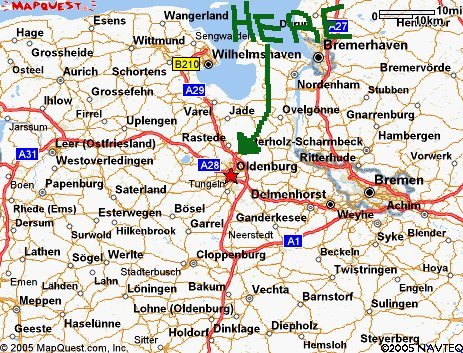
I lived and studied at the German university in Oldenburg which is near Bremen, and about two hours east of Hamburg, Germany. Clearly visible on the map are Bremen and Twistringen, Germany. When I go back, I'd like to visit Hannover and Berlin, as well as Cologne. Also, I'd like to visit more German castles, Because I only visited two in Nuremberg. Click on the buttons on this page to see pictures and advice about studying abroad in Germany (and traveling advice for France), or click the links below to go to strive4impact.com's other pages. |
|
 The
Phones and the Internet The
Phones and the InternetInexpensive calling advice within North America, from North America to the world, and calling from anywhere in the world to North America |
 Jonathan's
VOIP page Jonathan's
VOIP pageWhat is VoIP? It lets you make a phone call from your computer to anywhere in the world! I pay only 4 cents per minute to call anywhere in Europe! Cheap rates for countries around the world. |
|
|
|
Helpful Germany Links page and the
Study
abroad advice page
cheap phone calls and Germany calling cards.
Main Page
Welcome
Activities
UNC
Impact
Photos My
writings
Web Design
Massage
Recommendations
Resume
Letters